



Merkez
+90 312 354 93 65
+90 312 354 93 66
AdresUzayçağı Cad. 1155. Sk. No:21 Ostim Yenimahalle / Ankara
E-PostaWeb Site
Sektörler
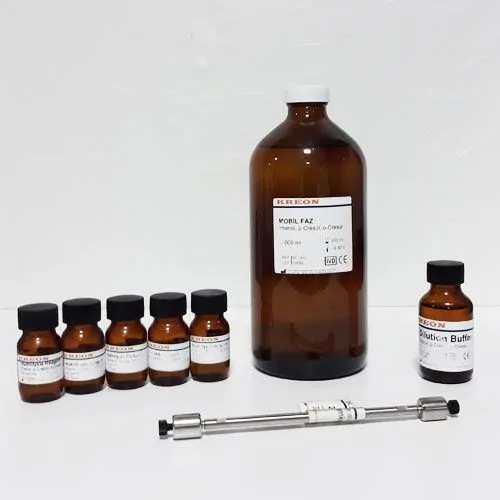
PHENOL/o-CRESOL (Urine) HPLC
PHENOL/o-CRESOL (Urine) HPLC
Phenol/o-Cresol (Urine) for HPLC
INTENDED USE
KR145 Reagent kit for the HPLC determination of Phenol/o-Cresol in urine.
KIT SPECIFICATION
Contents for 100 analyses:
| Cat no | Quantity | Reagents |
|---|---|---|
| KR1451 | 1000 mlx1 | Mobile Phase |
| KR1452 | 0.5 mlx1 | Urine Calibrator |
| KR1453 | 5 mlx1 | Internal Standard |
| KR1454 | 15 mlx1 | Hydrolysis Reagent |
| KR1455 | 50 mlx1 | Diluting Reagent |
ACCESSORİES
| KR1457 | 1 pc. | HPLC Column for the Analysis of Hemoglobin Phenol/o-Cresol in urine |
|---|---|---|
| KR1450 | 100 pcs. | Autosampler Vials with Teflon Caps |
CONTROLS
| KR1458 | 0.5 ml x1 | Urine Control, Level I |
|---|---|---|
| KR1459 | 0.5 ml x1 | Urine Control, Level II |
INTRODUCTION
Phenol is toxic by itself and is absorbed through the skin, respiratory system, and in accidental cases, through the digestive system. In the organism Phenol is partially conjugated with sulfuric acid and glucuronic acid.
TOXICITY OF PHENOL
Acute poisoning: by accidental ingestion occurs and leads to convulsions and rapid collapse. Phenol is irritating to mucous membranes, eyes and skin. Chronic intoxication: esophageal pain, headaches, dizziness, anorexia, and acidosis, nausea, vomiting and diarrhea.
o-Cresol is a urinary metabolite of toluene, a substance that is used in the production of materials in current use (glues, paints, lacquers, inks, etc..) and is also present as environmental micro pollutant: this means that the entire population is exposed to small concentrations of Toluene. In addition a source of indoor important Toluene is formed from tobacco smoke. Toluene is absorbed through the lungs and more slowly through the skin; in the organism is found in the first place in the blood, then is deposited in the adipose tissue. 20% of the absorbed dose is eliminated as is the respiratory system, 80% is biotransformed: the major metabolites are hippuric acid, o-cresol and benzoic acid
TOXICITY OF O-CRESOL
Acute exposure: irritation of the upper respiratory tract and central nervous system depression. Chronic Exposure: alcohol intolerance, headache, and sleep-wake rhythm disorders, symptoms in the liver (hepatomegaly) and the kidney (nephrotoxicity).
EQUIPMENT AND INSTRUMENTAL PARAMETERS
The analysis of Phenol/o-Cresol requires a HPLC including gradient system with HPLC pump, autosampler, autoinjector and FLD detector. The use of a solvent degasser prevents air bubbles and ensure a stable baseline.
Sampler: Injection volume 30 μl, analytical run time 10 min..
HPLC pump: Flow rate 0.6 ml/min is recommended
Column temperature: Ambient (~25 °C)
FLD detector : λEX =270nm , λEM =300nm
COLLECTION AND STORAGE OF PATIENT SAMPLES
The sample material is 24 hours urine. Storage life at room temperature is about 1 day, refrigerated (+2 to +8 °C) up to 1 week and frozen below -20 °C up to 6 months.
SAMPLE PREPARATION PROCEDURE
100 μl urine sample is added to vial with teflon cap.
50 µl internal standard is added.
150 µl hydrolysis reagent is added.
Vortex the mix for 10s.
Incubation is carried out at 80°C for 20 min.
500 µl diluting reagent is added to vial when sample comes to room temperature.
Vortex the mix for 10s.
The samples are stable for 4 days at 2-8 oC.