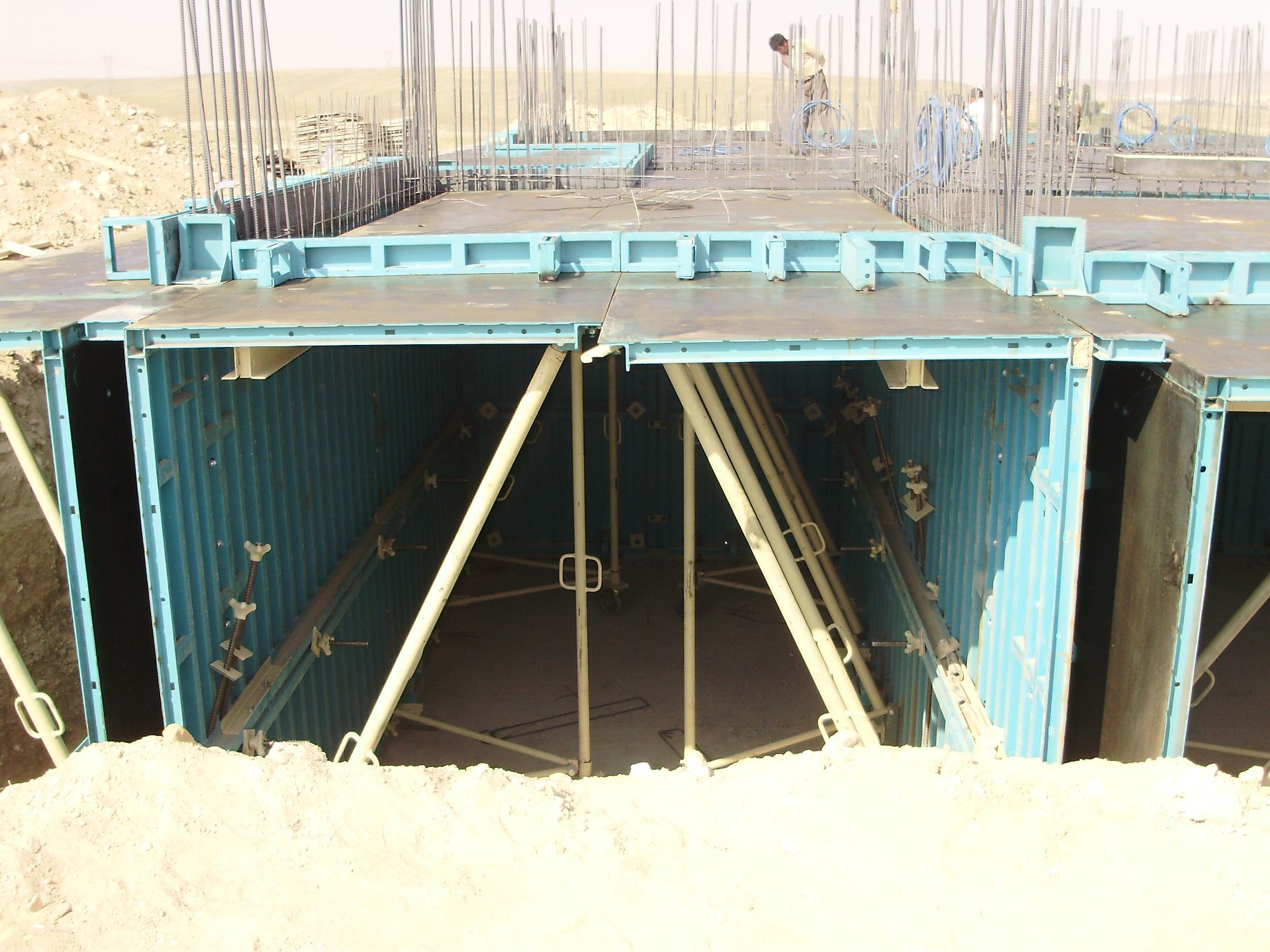
TÜNEL KALIP UYGULAMALARI İLE İLGİLİ BİLGİLER;
1-TÜNEL KALIBIN KURULMASI:
Montajı tamamlanan kalıp, temel üzerine yerleştirilmeden önce temel üzerine aks betonu dökülür, ölçü ve gönyelerine çok dikkat edilmelidir. Zira hatalı ölçüleri düzeltmek için sonradan kırmak ve yeniden dökmek zorunda kalırsınız.
Dökülen aks betonlarının üzerine her oda için kot çizgileri çizilmelidir. Bu da döşeme üstünden 67 mm’dir. Bu işlemden sonra montajı tamamlanmış tüneller temel üzerindeki yerlerine taşınmaya başlar. Yarım tüneli aks betonuna dayamadan önce varsa yarım tünel üzerinde perde rezervasyonu ve tesisatlarla ilgili malzemeler dik panoya yerleştirilir ve pano akslara alınıncaya kadar itilir. Pano krikoları ile kod çizgisine kadar getirilir.
Dikme tekeri ile tünelin şakülü ayarlanır, dik panolara bulon ve koniler yerleştirilir. Perde alın elemanlarının yerinde olup olmadığı kontrol edilir. Perde demiri pas payları yerleştirilir.
İkinci yarım tünel aynı şekildi diğer aksa yerleştirilir, aynı işler yapılır.
Her iki tünel bağlama kancaları ile birbirlerine bağlanır.
Dikme tekerleri artık kullanılmayacağından yukarı doğru vidalanarak yerden irtibatı kesilir.
Yarım tünellerin montajı bittikten sonra kalıp çıkarma iskeleleri yeni yerlerine taşınır.
İlk montajda kalıbın reglajını yapınız. Bunun için düzgün bir mastarı yatay panoların üzerine uzatarak kontrafişler yardımıyla yatay panoları mastarına getiriniz. Ayarsız kontrafişleri ayarlayarak setüskür civatası ile sabitleyiniz. Bu arada tünellerdeki yatay panolara ters sehim veriniz. (Tünel açıklığı 1 m için 1 mm olarak hesaplanır yani %1)
Kod çizgisine getirilerek kabaca ayarı yapılan tünelleri (her açıklığın 4 ayrı noktasında) nivo ile koduna getiriniz.
Döşeme alın elemanlarını ölçüsüne getirerek civatalarını sıkınız.
Bulon somunlarını sıkınız ve pano krikolarının hepsinin yükte olup olmadığını tekrar kontrol ediniz.
Döşeme üzerindeki rezervasyonları ve tesisatları yerlerine yerleştiriniz
Aks betonu ve elemanlarını yerleştiriniz.
Tünel ısıtıcılarını tünelin içine yerleştiriniz ve perde brandalarını kapatınız.
Betonu dökünüz; Beton döküm sırası orta perdeden başlayıp yanlara doğru eşit şekilde dökülmelidir. Beton döküm sırasında çift vibratör kullanılmalı ve önce büyük çaplı (vibratör ucu) hemen arkasından küçük çaplı şişe kullanılmalıdır. Tünel ısıtıcılarını beton dökümünden yaklaşık 1 saat sonra yakınız, zira beton döküm sırasında betonun mevcut ısısı ile kür ısısı birleştiğinde fazla bir ısı oluşacağından beton yanabilir.
2-TÜNEL KALIBIN SÖKÜM TALİMATI:
a)Isı izalasyon çadırları açılır ve ısıstıcılar toplanır.
b)Bulonlar sökülür ve sırt U’larının üzerine takılır. Somunlar muhafaza edilerek bir sonraki operasyona kadar muhafaza edilir.
c)Döşeme alın elemanları civataları gevşetilir.
d)Aks betonu köşebentler ve mesafe ayar elemanları sökülüp döşemenin üzerine bırakılır.
e)Döşemeye montajlı rezervasyonların civataları çözülerek yerlerinden alınır. Döşeme ve perdelerdeki rezervasyonlar ile elektrik ve tesisatları ile ilgili vida ve civataları sökülür ve kontrol edilir.
f)İki yatay panoyu bağlayan bağlama kancalarını sökünüz.
g)Birinci yarım tünelin pano krikolarını düşürerek yarım tünelin tekerler üzerine düşmesini sağlayın.
h)Birinci yarım tüneli elle iterek dışarı çıkarın ve ağırlık merkezi deliği döşemenin dışına çıkıncaya kadar devam ediniz. Kalıp çıkarma iskelesi üzerine çıkan yarım tünele kaldırma üçgenini takınız somunun iyice sıkılmasına dikkat ediniz.
i)Yarım tüneli vinçle kaldırarak bir sonra kullanacağınız yere taşıyınız, kalıbı temizleyip kalıp yağı ile yağlayın. Yarım tüneli aldığınız yerdeki döşemeyi teleskopik direklerle destekleyin ve ikinci yarım tünelin pano krikolarını indirip aynı şekilde ikinci yarım tüneli yerinden alınız.
j)Bağımsız montaj edilmiş tüm rezervasyonları yerlerinden çıkararak temizleyip yağlayıp yeni yerlerine taşıyınız.
k)Konik çıkarma zımbası ile konikleri yerlerinden çıkararak temizleyip yağlayınız kayıp olmaması için bir sepette muhafaza ederek yeni yerine taşıyınız.
l)Kalıp alınmasından sonra beton yüzeylerinde oluşacak arızaları tamir ediniz, konik deliklerini doldurunuz, böylece yapıyı diğer işlere hazırlamış olursunuz.
3-BİR SET TÜNEL KALIP İÇİN ELEMAN DAĞILIMI:
- Tünel kalıp mühendisi 1 kişi
- Tünel formeni 1 kişi
- Tünel kalıp ustası 10 kişi
- Tünel kalıp demircisi 10 kişi
- Tünel kalıp elektrikcisi 4 kişi
- Tünel kalıp sıvacısı 1 kişi
- Tünel kalıp kulevinç operatörü 1 kişi
- Tünel kalıp vibratörcüsü+betoncusu 5 kişi
TOPLAM 33 Kişi
Bu eleman sayısı ile her kalıpla her bir döküm yapılmalıdır. Kalıp işleyiş sistemi; Ortalama saat 15 gibi kalıp betona verilir. Tünel montaj ekibinin bir bölümü işi bırakıp paydos yapmaktadır. Beton mukavemeti yaklaşık 8 saat sonra elde edilmektedir. Beton dökümü yaklaşık ertesi gün saat 5’te kalıp sökümüne başlanıyor ve kalıbın montajını tamamlayıp normal saatinde betona veriyor.
4-TÜNEL KALIBIN PERİYODİK BAKIMI:
a)Tüm kalıp,rezervasyonlar betondan çıkarıldıktan sonra kalıp spartulası ve sert tüylü bir fırça ile temizlenir. Dik panolara hemen kalıp yağı sürülmelidir.Yatay panolar hasır çeliğin döşenmesinden hemen önce yağlanmalıdır.
b)Pano krikoları,kontrafişler, dikme tekerlerinin ve pano tekerlerinin hareketli yerlerini gresle yağlayınız.
c)Yatay ve arka panoalrdaki konik civataları blon ve somunlarını rezervasyonlardaki tüm hareketli parçaları viskositesi yüksek bir yağ ile yağlayınız.
d)Herhangi bir parçanın darbe sonucu hasar görmesi, kırılması,ezilmesi veya kaybolması halinde bunlar derhal orjinali ile değiştirilmelidir. Aksi halde hasarlı teçhizatla çalışmak hem iş güvenliğini tehlikeye sokar, hemde beton kalitesini doğrudan etkiler.
e)Pano krikoları, tekerleri, kontrafişleri, dikme tekerleri ve hareketli diğer parçaları her hafta gözden geçirilmelidir.
f)Kalıp çıkarma iskeleleri ve dış pano iskeleleri,dış cephe iskeleleri sürekli kontrol altında tutulmalıdır. Gevşeyen hasar gören yerler tamir edilmelidir.
g)Pano kaldırma üçgeni günlük kontrol edilmeli ve gevşeyen civataların olup olmadığı ile kaynak ve halatların sağlamlığı devamlı ve özenle kontrol edilmeli ve kaldırma aparatı dişli mili ve somunu 6 ayda bir yedeği ile değiştirilmelidir.
A-MONTAJ SAHASI:
Ekte verilen şama ve açıklamalara uygun şekilde hazırlanmalıdır.
B-KALIP VE EKİPMENLARIN YERİ:
Hazırlıkların yapılacağı saha, ilk uygulamanın yapılacağı temele yakın seçilmelidir.
C-BULUNDURULMASI GEREKEN (KULLANILACAK) VİNÇ:
Montaj çalışmalarının başlamasından sonra bütün gün montaj işi için çalışmaya hazır ve kaldırma kapasitesi yaklaşık 30 mt’de 1 ton olarak düşünülmelidir.
D-GEREKLİ İNSAN GÜCÜ:
4-5 kişilik montaj ekibi
2-3 kişilik iskelelere ahşap çakılması ve ilk aks betonlarının dökülmesi için
Montaj ekibi olarak teknik elemanlarımız emrine vereceğiniz kişiler,sizin daha sonra tünel kalıp işini yürütecek kişiler olacağından askari kaynak bilgisine sahip ustalardan oluşmalıdır.
E-BULUNDURULMASI GEREKEN EL ALETLERİ VE GEREÇLER:
| Manivela |
5-adet (Bunları anlaştığınız
taşeron ekipte getirebilir.) |
| Yağ pompası |
1-adet |
| Elektrik ark kaynak makinası |
1-Takım |
| Oksijen kaynak makinası |
1-Takım |
| Elektrikli matkap ve uçları |
1-Takım |
| Elektrikli taşlama spiralı |
1-adet |
| Çekiş (2 kg) |
5-adet |
| Balyoz (8 kg) |
1-adet |
| Anahtar takımı |
|
| -Küçük lokma takımı |
1-takım |
| -22 Lokma |
5-adet |
| -Lokma cırcır kolu |
5-adet |
| -Lokma fırfır kolu |
2-adet |
| -Büyük lokma takımı |
1-adet |
| -Büyük lokma (38 mm) |
5-adet |
| -Büyük lokma kolu |
5-adet |
| -Açık ağız anahtar takımı |
2-takım |
| -Açık ağız anahtar 22-20 |
10-adet |
| -Açık ağız anahtar 17-13 |
5-adet |
| -Açık ağız anahtar 28-26 |
5-adet |
| |
|
BİR SET İÇİN
F-İLK AKS BETONLARININ HAZIRLANMASI:
Tünel kalıplar proje ölçülerine göre milimetrik olarak imal edilmiştir. Bundan dolayı temel ölçülerinde ve kotunda olan bütün hatalar aks betonunda yok edilir. Şöyle ki: Aks betonu,çatı kotundaki aks betonlarının bir izdüşümü olmalıdır.
G-HAZIRLANMASI GEREKEN TESİSAT REZERVASYONLARI ÇİZİMLERİ:
Betondan çıkmasını istediğiniz tüm boşluk ve tesisat için kalıp üzerindeki yerlerini gösterir. Rezervasyon planlarını, elektrik ve su tesisatı bağlantı deliklerini açık bir şekilde çizmeniz gerekir. Bu çizimler için göndereceğimiz teknik eleman size yol gösterici yardımda bulunabilir.