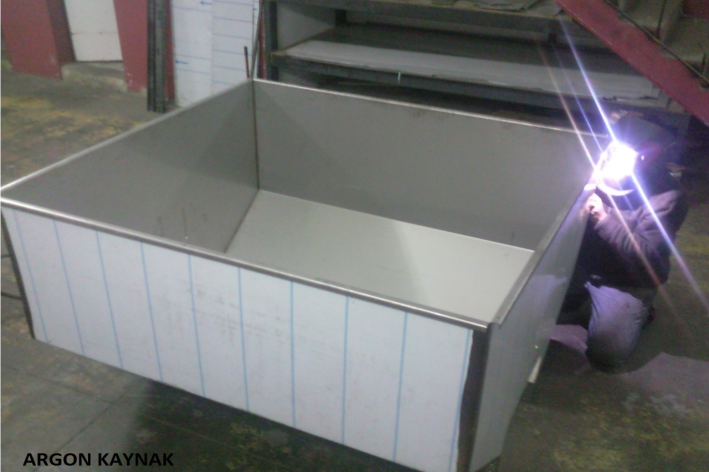
Gas arc welding with continuous wire under a protective atmosphere is defined as MIG (metal inter gas), MAG (metal active gas) or GMAW (gas metal arc welding). In continuous wire arc welding, the required heat energy is generated by the electric arc created between the material and the continuous wire. The welding torch feeds the additional wire to the welding area, at the same time it sends the shielding gas to the welding area, ensuring that the welding area and the weld pool are protected from the bad effects of air. The naming of the method changes according to the gas shielding. If welding is done under an inert gas atmosphere, it is called MIG. The welding method under active gas shielding is called MAG.
In the use of some cored wires, there is no need to use gas in the welding circuit, this method is defined as welding with non-gas cored wire. Here, the welding zone and its bath are protected by the gas formed by the wire core.
B. WELDING CIRCUIT
1. Power supply (Welding Machine)
2. Torch and torch cable
3. Wire feed unit
4. Water cooling unit
5. Gas cylinder and pressure reducer
6. Work cable and pliers
1. Power Supply (Welding Machine)
The purpose of the power source is to create an electric arc between the continuously depleted wire electrode and the base material, and to ensure that the wire and the shielding gas are continuously sent to the welding area. In MMA and TIG welding, we have only one parameter setting, current setting, in power source. In MIG / MAG power supplies we have 2 parameter settings. Our first parameter is the source voltage. Our second parameter is wire speed (welding current). Power supplies are divided into 2 groups.
a) Direct current ( DC ) power supplies
Direct current power supplies are general use power supplies due to their high stability characteristics. The method has flexibility due to voltage and wire speed variability. Therefore, there are different mechanisms in the transition of the filler metal to the weld pool. These are called short circuit, spherical and spray metal transition.
b) Pulsed current power supplies
These are the power sources in which the welding current is produced as a pulse with the help of adjustment mechanisms. They are used with high efficiency, especially in materials where we want the heat input to be low. Melting of the pulsed current at high amperage values, and cooling and smoothness of the weld pool is provided at low amperage values. It is the machine characteristic used in the MIG BRAZING method.
i) Direct current straight biasing
In straight polarity, the torch and torch lead are connected to the negative ( - ) pole of the power supply, and the work clamp and cable are connected to the positive ( + ) pole of the power supply. This type of connection is only valid for the use of cored wire.
ii) Direct current reverse polarity
In reverse polarity, the torch and torch lead are connected to the positive (+) pole of the power supply, and the work clamp and cable are connected to the negative (-) pole of the power supply. This connection type is the general usage connection type.
2. . Torch and Torch Cable
The torch delivers the weld metal and shielding gas to the weld area. In addition, it is completely isolated in terms of working safety. It covers the current control button, throttle and wire speed adjustment buttons on it. The harness includes the current conductor control cable, the gas hose, the water cooling hoses, if any, and the wire feeder guide. There are many different types of welding torches available in the market.
Water-cooled torches are used at high amperes, over 300 amps, or pulsed currents. Air-cooled torches are shielding gas-cooled general use torches with welding amperes less than 300 amps. Swan neck torches are gas cooled torches used for low current welding applications.
3. Wire Feeding
Wire feeder is a motor driven mechanism to drive the reeled wire into the welding area. Wire feed speed can be selected by the setting of the motor regulator. The selected wire speed needs and defines a current for melting. There are 4-wheel or 2-wheel systems from wire feeding mechanisms. 4-wheel systems are much more useful than 2-wheel systems.
4. Water Cooling Unit
A water cooling unit is used to prevent damage to the torch due to heating in welding with high amperage. The circulation pump in the cooling unit ensures that the water circulates continuously in the torch, preventing the torch from heating up.
5. Gas Cylinder and Pressure Reducer
The gas cylinder contains one of the shielding gases such as argon, helium, carbon dioxide or a mixture. With the help of a suitable pressure reducer, it is sent to the welding area in desired quantities.
6. Work Cable and Pliers
The work cable and its pliers are the power supply connection to the main material to complete the electrical circuit. Appropriate cable cross-section and length should be selected according to the welding current.
C. ARC STRENGTH, HOT START AND NON-ADHESIVE MECHANISMS
It should include special mechanisms that improve power supply usage characteristics. These mechanisms are defined as arc strength, hot start and non-stick properties.
- Arc power ; facilitates the transition of the electrode to the base metal by melting. It prevents the arc from extinguishing during the weld pool contact with the electrode.
- Hot start ; At each welding start, the current is kept higher than the required value for welding, facilitating the formation of an electric arc between the base material and the electrode.
- Non -adhesion; If the electrode seems to stick to the main material, this mechanism automatically shuts down the power supply, so that adhesion does not occur and possible damage to the electrode holder is prevented.
C. PROTECTIVE GASES
Shielding gases used in MIG / MAG welding methods are divided into 2 main categories. Noble gases and active gases. Argon, helium and argon-helium mixtures fall into group 1, carbon dioxide and argon-oxygen or argon-helium mixtures fall into group 2.
Argon (Ar) is a noble gas produced by distillation from the atmosphere. Although it contains unwanted contents such as oxygen, nitrogen and water vapor since it is produced in air, it is the most suitable gas for welding applications. The use of argon provides high arc stability in MAG applications. Due to the low conductivity, the center of the arc remains at a high temperature, making the passage of metal droplets across the arc much more fluid.
Helium is a noble gas that is much more expensive than argon, rarely extracted from the atmosphere, generally underground. Compared to argon, a more unstable arc is obtained with helium. But the penetration is very high compared to argon. It is generally used in thick and high thermal conductivity materials, such as copper and aluminum. Since helium is a lighter gas than air, its usage amount is higher than argon to provide the necessary protection in the weld pool.
Carbon dioxide is an active gas found in the air and underground. The general problem with this gas is an unstable arc and increased spatter losses. To minimize splash losses, the arc length should be shortened and kept as constant as possible. Welds made in carbon dioxide protection have high penetration.
Active mixtures often use argon-oxygen, argon-oxygen-carbon dioxide, or argon-carbon dioxide mixtures to take advantage of gases. Noble gases show their protective properties at all temperatures, with the participation of active gases, a more stable arc and metal transition to the weld pool is provided. These are made without damaging the protective properties.
D. WELDING WIRES
Welding wires are classified according to their chemical composition and whether they are solid (full) or cored. There should be no oil or moisture on the surfaces of the wires, they cause welding defects such as cracks and pores in the weld. Uneven wire wraps can also cause uneven wire feeding and improper welding in some cases.
Solid wires generally have similar compositions to the base material and contain additional elements that clean the base material. General usage diameters are 0.6 – 0.8 – 0.9 – 1.0 – 1.2 – 1.6 mm. Gas shielded cored wires are tubular wires with powder flux. Flux does the job of covered electrodes, which their covers do. The powder can be granular or flux rutile, basic or with special properties.
Compared to solid wires, cored wires have better arc stability and better penetration and a nicer weld appearance. Post-weld cleaning is less. The risk of fault formation in the weld, such as porosity, is lower. In the use of cored wire, a slag layer is formed as in the covered electrodes and this slag layer must be cleaned between passes. General usage diameters are 0.6 – 0.8 – 0.9 – 1.0 – 1.2 – 1.6 mm.
E. WELD METAL TRANSFER METHODS
The gas used, the type of power source, the diameter of the electrode and the current values used cause the differences in metal transition mechanisms in the gas arc welding. There are 3 types of metal transition mechanisms depending on the above parameters. A ) short circuit, b) spray arc, c ) pulsed spray arc
a) short circuit; The metal transition here occurs when the electrode contacts the weld pool and creates a short circuit, and as a result, metal drops break off and pass into the weld pool. A short-circuit metal transition can be created using wires with current values of approximately 200 amps and fine diameter 0.6 to 1.2 mm. It is obtained with direct current power supplies.
b ) spray arc ; It is the material transition mechanism that occurs at high welding current values, without short-circuiting the weld pool of metal droplets. Here it is the high current that provides the metal transfer. Occurs at current values above 200 amps and wire diameter over 1 mm, when the shielding gas is argon.
c ) pulsed spray arc ; occurs only in pulsed current power supplies and under pulsed current conditions. It is also possible to occur at low current values due to the pulsed current. The material is particularly suitable for welding aluminum and stainless steels, as the heat input is low.
E. MATERIALS THAT CAN BE WELDED BY THE MIG/MAG METHOD
1) Carbon steels
Carbon steels can be welded by the MAG method in direct current reverse polarity. Carbon dioxide mixtures can be used in this method. Increasing the amount of argon in the mixture increases arc stability.
It can be welded with desired properties in all welding positions in thick materials. It provides quality welds by cleaning the silica and manganese weld metal in the wire. In case the material thickness exceeds 3 mm, weld mouth should be opened to the main material.
2 ) Stainless steels
Stainless steels can be MIG welded in direct current reverse polarity. In this method, pure argon or argon-rich argon-oxygen-carbon dioxide mixtures are used. The percentage of argon in the mixture cannot fall below 95%. In cases where the material thickness exceeds 2.5 mm, the weld mouth should be opened to the main material. Welding wire should be used in composition suitable for the main material.
3 ) Aluminum and its alloys
Aluminum and its alloys can be welded by MIG method in direct current and pulsed current reverse polarity. The shielding gas must be pure argon. Pure helium or helium-argon mixtures can also be used.
Spray or pulsed transition technique is used in horizontal welds, and short-circuit metal transition technique is used in thin materials and corner welds.
4) Materials such as nickel and its alloys, copper and its alloys can be welded by MIG method. Direct current reverse biasing is used. It is necessary to use wire diameters, current values and appropriate wire qualities suitable for material thicknesses and positions.